I am learning flutter from JustAcademy, They provide very much great environment where people gather and work simultaneously. totally project based training institute.
MOHD ABU BAKAR ANSARI
Flutter Developer
Awesome Experience. I am a Front-end Web Designer working at Star India for 3 years now. I applied for Full-stack development and my experience has been phenomenal & they really do help with placements exceptionally. Thank you Roshan sir so much.
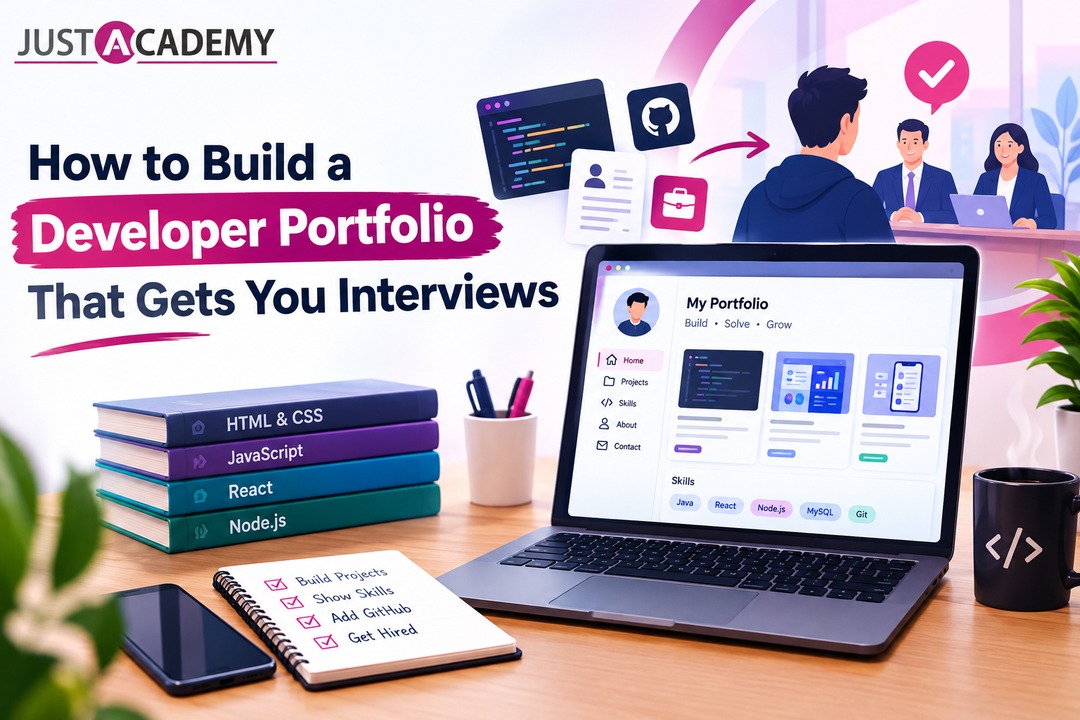
A practical guide for Pune freshers and career switchers on designing a developer portfolio website that recruiters open, remember and reply to
Picture a recruiter in Pune on a Monday morning. Two hundred job applications are waiting, a hiring deadline is set for Friday, and the coffee has gone cold. She is not reading essays. She skims the first lines of each application, looks for a link, and clicks only the ones that promise proof. More often than any degree, that link leads to a developer portfolio website, and the candidates who have one get a very different Monday than the ones who do not.
This guide is for learners and career switchers around Pune who want their web developer portfolio to open doors instead of gathering dust. Most of the advice comes from the way mentors work with students during live interactive sessions, where an instructor led class explains an idea and a mentor led review pushes you to apply it in a project you can be proud of. If you already know you want to build complete products from the database to the screen, the MERN stack developer bootcamp in Pune is a natural fit, and if you would like to experience a real class before deciding anything, you can book a free demo session and watch how the teaching actually feels.
Some context on location. JustAcademy runs its offline institute in Mumbai, which many learners regard as the best course in Mumbai for practical technology training. Pune learners do not need to relocate, because the same live and interactive batches run online with the same teaching approach, and placement support follows you regardless of how you attend. Everything below is written with that Pune and Mumbai reality in mind.
Here is what you will walk away with: a clear reason to build a portfolio, a place to host it, a homepage layout that works in seconds, project ideas that prove real skill, the right words to put around them, and a plan to get the whole thing noticed.
Why a Developer Portfolio Website Beats a Resume in Pune Hiring Rounds
A resume makes claims and a portfolio shows receipts
Nobody is telling you to throw your resume away. Use the best resume app you can find, and if budget is tight, there are plenty of people who look for an online resume maker free of charge just to get a tidy layout. But a resume is a set of statements you have written about yourself, and every other applicant is writing similar statements. A portfolio is different because the reader can click, scroll, break things and judge for themselves. A line that says you know React tells the reader almost nothing. A live project that filters products, remembers a cart and loads fast on a phone tells them the whole story.
What Pune employers are really screening for
Pune is an unusual hiring market. Founders in Baner and Wakad want people who can pick up a ticket on day one, while the large service and product companies around Hinjewadi and Kharadi need to sort through thousands of job applications without losing good candidates. In both cases the screening question is the same: can this person build something that works? When a founder is busy hiring employees for a small product team, a link that opens cleanly on a phone between two meetings is worth more than a three page PDF. In a larger company, a portfolio link near the top of your application makes the recruiter slow down and read the rest.
What a developer portfolio website actually is
Let us define it in plain words. A developer portfolio website is a small public site where you collect your best work, explain how you think and make it easy to be contacted. It is closer to a personal website than to a company site, and it has one job, which is to prove that you can ship. A personal web page with three honest projects and clear writing will beat a flashy site with twenty half finished demos almost every time. Recruiters do not want decoration. They want evidence, and evidence is exactly what a well planned web developer portfolio hands over in under a minute.
How your resume and portfolio work as a team
The smartest applicants treat the two documents as partners. The resume is the short, scannable summary that gets you through the first filter, and the portfolio is the deeper proof waiting one click away. Later in this guide we will look at the resume section inside your site, which connects both worlds so a recruiter never has to hunt for either.
Where Your Work Should Live Before Anyone Asks to See It
Coding it yourself or using a platform
The first decision when setting up a personal website is whether to code it or assemble it. If you are aiming at front end or full stack roles, coding it yourself is part of the point, because the site itself becomes a project. Build a personal website with plain HTML, CSS and JavaScript first, and reach for a framework only when the content truly needs one. Even something as basic as creating a web page from a blank file teaches you how the browser reads structure, so do not skip that step. If the language side still feels shaky, the JavaScript training in Pune classes are built around live practice, where a doubt gets answered on the spot instead of sitting unanswered in a comment thread.
If you are aiming at data or testing roles, a builder is perfectly respectable. There is no single best website building platform for everyone. The right one is the one you will keep updating, because a neglected site with a fancy theme looks worse than a simple one that was touched last week.
The honest cost to build a website of your own
People worry about the cost to build a website far more than they need to. A domain name and basic hosting are a small yearly expense, and free hosting exists for static sites. Website design cost only balloons when you pay someone else to do the work, and most searches for website developers near me come from small businesses that need a company site, not from students building a first portfolio. For a learner, the smarter investment is time. Two focused weekends will give you a clean site, and a domain with your own name on it makes the whole thing feel professional.
Four common routes side by side
Most learners end up choosing between the four routes below. Here is how they compare in everyday terms.
Route
Best for
Effort
Money
Watch out for
Hand coded site with HTML, CSS and JavaScript
Front end and full stack learners
Highest
Domain plus basic hosting
Needs polish and testing on phones
Website builder
Learners short on time
Low
Free plan or a small monthly fee
Generic look and limited control
Free static hosting such as GitHub Pages
Beginners and career switchers
Medium
Very little
Plain address unless you add a domain
Templates from online portfolio sites
People who want a ready structure
Low to medium
Free or paid
Recruiters may have seen the same layout
Whichever route you take, recruiters rarely care about the tool behind your site. They care about speed, clarity and whether the projects you link to actually run when clicked.
Portfolio Homepage Design Choices That Recruiters Notice in Ten Seconds
The three jobs your portfolio homepage must do
Your portfolio homepage has to say who you are, show what you do and point to the next step. That is the whole list. Open with your name and role, follow with one sentence about the work you want, and place your two or three strongest projects right below. Good portfolio homepage design avoids autoplay music, spinning logos and walls of text. Before anyone scrolls, a visitor should know your name, your specialty and how to contact you.
Personal site design that signals skill quietly
Good personal site design is mostly restraint. Pick one readable pair of fonts, a small colour palette and generous spacing. Check the layout on a small screen, because recruiters do open links on phones. Portfolio web page design also rewards speed, so compress your images and avoid heavy animation libraries that slow the first load. For inspiration, browse some of the best web developer websites and notice how many are simple, fast and confident instead of crowded. Bookmark a few website portfolio ideas, then close the tabs and sketch your own version on paper, otherwise you will end up with a copy of someone else.
A personal brand website with a human voice
A personal brand website is not about turning into an influencer. It is about sounding like a person with a point of view. Personalised websites feel different from templated ones because the writing carries a voice. Say what you enjoy building, what you are learning this month and what kind of team you would like to join. The personal branding sites that work best often keep a short notes section where the developer explains a bug they fixed or an idea they finally understood. A personal page website with a few honest paragraphs like that builds trust faster than any badge. Call it a personal site or a portfolio, the test is the same: does a stranger finish reading with a clear picture of you?
Portfolio design for web developers chasing different roles
Portfolio design for web developer roles on the interface side should show craft in the interface itself, so spend time on states, spacing and accessibility. Portfolio websites web developer candidates build for backend roles can be plainer, with more room for architecture sketches and API notes. Match the site to the job you want, not to the job you think looks most impressive.
Project Ideas for a Web Developer Portfolio That Prove Real Skill
The projects section is the heart of the site. The design, the writing and the domain exist only to bring a reader here and keep them here. Three to five carefully chosen projects are plenty, as long as together they show range without scattering your story.
Build web application projects around boring real problems
Skip the calculator and the to do list, because reviewers have seen a thousand of them. Build web application projects around problems you or the people near you actually have: a tiffin subscription tracker, a housing society maintenance manager, a small clinic appointment planner. Real problems force real decisions about data, validation and edge cases. Mention the web development apps and tools you relied on, such as Git, Postman and browser dev tools, so the reader knows you work like a professional. Describe what went wrong first as well. Honest struggle reads as authentic, and authenticity is memorable.
Build ecommerce website projects that survive an actual checkout
If you decide to build ecommerce website projects, take them all the way: product listing, cart, address form, a payment gateway in test mode, order history and a simple admin view. Most learners stop at the product grid. The ones who finish the checkout flow stand out because they have touched the parts where real businesses lose money. On the MERN stack this single project can carry half your portfolio, and a mentor led program built around exactly this kind of product gives you feedback at every stage.
React Native vs Flutter for Beginners: Which Mobile Project Belongs in Your Portfolio
Sooner or later every learner asks the question, and the honest answer for react native vs flutter for beginners is that either one works if you finish something. React Native suits people who are already comfortable with JavaScript and React. Flutter, built on Dart, gives very consistent interfaces across devices and often feels structured to people from Java or C sharp backgrounds. For a portfolio, what matters is that the app can be installed or at least shown through a short screen recording, that it talks to a real backend and that you can explain one tricky decision you made.
The choice of application development software matters less than shipping. Arguments about the best app development software are mostly noise, and any app development software that lets you finish a working build is good enough, so use whatever editor and emulator setup keeps you moving. Many people who later become the best mobile app developers on their team started with one small, completed app instead of five abandoned ones. If you plan a mobile career, an app building course with live code reviews can save you months of guessing, and a finished app tells a recruiter that you think like an application developer, not someone who only follows tutorials.
A testing project for people who enjoy breaking things
Quality assurance teams are hungry for candidates who can show automation instead of only talking about it. A small framework that tests a real public website, with clear reports and a readable README, is a strong addition to any projects section. Learners drawn to that path often join the Selenium training in Pune batches, where instructor led classes cover the framework and mentor led sessions help you organise the repository so a reviewer can run it in a few minutes.
A data project for analyst roles
For analysts, one dashboard with a clear business question beats five random notebooks. Pick a public dataset, clean it in Python, ask one sharp question and present the answer as a short story. Certificates can support that story without replacing it, and this guide to which Python certificate really boosts a career in 2026 is worth reading before you spend money on any of them.
Interview season brings the same project back into the spotlight. If you want to prepare for data analyst interview rounds, your dashboard is the best rehearsal material you have. Real data analyst interview preparation begins with your own work: why you chose that dataset, how you handled missing values and what the chart is supposed to help a manager decide. Data analyst interview prep also means practising the story out loud, ideally with a mentor playing a tough hiring manager. And when you compare the best data analysis courses, choose the ones that make you present your findings instead of just watching lectures.
Writing the Words Around Your Work
The resume section that belongs on your site
A resume section on your portfolio should not be a copy of your PDF. Keep it short: your current focus, key skills, education, any internship and a download link. Write in plain sentences and put your target role in the very first line, because recruiters skim for role clarity. A skills list also works better when it is grouped by how you use each skill, for example languages you write daily and tools you have touched a few times. That small honesty makes an interviewer trust the rest of the page.
Case studies in five honest paragraphs
Every project in the projects section deserves a short case study. Aim for five paragraphs: the problem, your approach, the stack and why you chose it, one hard bug or decision, and what you would change next. Add a live link, a code link and a screenshot. Keep the language human. A sentence like we struggled with slow queries until we added an index is far more convincing than a phrase like leveraged cutting edge solutions, which says nothing at all.
Small details that quietly decide interviews
Give visitors an easy way to reach you: a clear email address, plus LinkedIn and GitHub links. Write alt text for your images, add a favicon and give every page a proper title. Then open the site on an actual phone, not just a browser window resized on your laptop. One more useful test is to ask a friend from outside tech to read the top of the page and tell you what you do. If they hesitate, rewrite it. Small touches such as a working contact form or a friendly 404 page quietly say that you finish what you start.
A portfolio is not a monument. Once a month, spend an evening adding a finished project, dropping the weakest one and adjusting the headline so it matches the roles you are chasing now. Recruiters notice fresh work, and a site that keeps improving suggests you keep learning even when nobody is grading you.
Mistakes That Quietly Sink Good Portfolios
Too many projects and too little depth
A long list of shallow projects tells a reader you enjoy starting things. Three deep ones tell them you know how to finish. If your GitHub is full of half built experiments, archive them and keep only the work you could happily discuss for a quarter of an hour.
Broken links and sleepy demos
Few things hurt trust like a demo that throws an error or a page that takes ages to appear. Free hosting plans sometimes put apps to sleep after a period of silence, so wake every demo the evening before an interview. Put a monthly reminder in your calendar to click every link on your own site as well.
Copying tutorials without making them yours
A tutorial clone is easy for a reviewer to spot. Change the idea, add features the tutorial never had, write the README in your own voice and say what you changed. Following a tutorial is a fine way to learn, but a portfolio has to show that you can think without one.
Leaving secrets and private details public
Keep API keys, database passwords and your home address out of public repositories. Store secrets in environment files, and share only the contact details you would be comfortable seeing on a noticeboard.
Choosing a Stack Without Losing Sleep
Ask around in any Pune study group and you will hear the same worry: which stack lands a job fastest? No stack wins everywhere, though a few patterns are worth knowing.
MERN, Java or something else
The JavaScript route runs through MongoDB, Express, React and Node, and the steady stream of react js developer jobs makes it attractive for freshers. Java has its own rhythm, with deep demand in banks, enterprise products and big service companies, so java jobs and full stack software engineer jobs that combine Spring with a React or Angular front end stay consistently available. Still torn? This candid comparison of MERN stack versus Full Stack Java and which career path looks better in 2026 weighs both sides fairly.
Learners fresh from a college syllabus often find a structured java language course familiar territory, while people from design or commerce backgrounds tend to warm up to JavaScript faster. Whichever you pick, developer jobs stop feeling mysterious once you read what companies actually ask for.
React Native vs Flutter for Beginners Is Really a Question About Your Target Job
Coming back to that long debate, react native vs flutter for beginners becomes easy the moment you look at job posts in your target city. If startups around you keep asking for React and JavaScript, React Native makes your portfolio more coherent, because your website, your web app and your mobile app then share one language. If you are drawn to product companies that build polished cross platform interfaces, Flutter can make you stand out. Coherence matters more than fashion. A portfolio where every project points in the same career direction reads like a plan, and a plan is what recruiters want to hire.
Treat job descriptions like a map
Open ten postings for the role you want and copy the required skills into a note. Whatever repeats most tells you what to build next, and that single evening can save you months. When you scan a naukri com job listing for a junior developer, watch which words keep returning, because those are the words your projects section and resume section should honestly reflect.
Getting Your Portfolio in Front of the Right People
Where your link should appear
Put the link at the top of your resume, in your email signature, on your LinkedIn headline, on your GitHub profile and in every message to a recruiter. Job applications that mention the site within the first two lines of a cover note are more likely to get opened. Click the link yourself before sending, because a dead link does more harm than none at all.
Using job apps and job application sites wisely
Even the best job apps and job application sites only reward people who apply with intent. Create alerts for the exact role you want, personalise the opening lines of each message and attach your portfolio link. Keep a simple sheet of where you applied so you can follow up after a week. Twenty thoughtful messages will almost always beat two hundred copied ones.
Job interview questions to prepare for once they open your site
Most interviewers open your portfolio during the call and choose a project at random. Expect to explain why you picked that stack, what broke along the way, how you tested it, how it would cope with more users and what you would change. These are the job interview questions to prepare for, and they feel easy when the project is truly yours. Rehearse each project for two minutes, then five, and keep one story about a mistake you fixed.
For a look at how JustAcademy organises this sort of preparation, you can browse the course brochure whenever it suits you.
How Mentor Led Live Interactive Training Builds a Stronger Portfolio
Live and interactive classes that fit a Pune routine
Portfolios usually die when a learner studies alone, meets a bug they cannot solve and quietly drifts away. Live and interactive classes take that wall down. In live interactive training you can ask the moment you are stuck, watch an instructor debug in real time and finish the class with working code. Pune learners join from home, from a hostel room or between shifts, and the fixed schedule keeps momentum alive. JustAcademy keeps its offline institute in Mumbai for those who like a classroom, and the live online batches bring the same energy to Pune and beyond.
The difference between an instructor led session and a mentor led session
In an instructor led session, the teacher explains concepts, syntax and logic to the whole batch. A mentor led session is more personal and centres on your project, your code and your gaps. You need both. The instructor hands you the map, while the mentor walks the road beside you and points out wrong turns. The combination turns someone who follows tutorials into a developer who can defend a portfolio across an interview table.
Skills based courses, certificates and placement support
Many learners collect a skillup certificate and are surprised when interviews still do not arrive. A certificate helps only when proof sits beside it. Skills based courses that finish with real projects, reviewed by mentors, provide both. JustAcademy, an ISO certified institute, backs its programs with placement support such as resume reviews, mock interviews and job guidance, so your portfolio has company on the way to the interview.
Before you sign up for a java language course, an app building course, a full stack bootcamp or any of the best data analysis courses, ask three simple questions. Will I build real projects? Will a mentor review them? Will someone help me present them? Three yeses mean you are in the right room.
For anyone learning python for beginners and aiming at analytics or automation, the Python training in Pune classes combine live teaching with projects that drop straight into a portfolio.
Conclusion: Your Next Two Weekends
Building a developer portfolio website is not a talent contest. It is a chain of small, honest decisions: where to host it, how to shape the homepage, which three projects to show, how to write about them and who to send the link to. Begin this weekend by booking the domain, sketching the homepage and finishing one project. Next weekend, write its case study, then hand the whole thing to a mentor or a friend and ask them to break it. Recruiters are not looking for perfection. They are looking for proof that you can learn, ship and improve, and a portfolio is the quietest, most convincing way to deliver it.
Ready to build yours with live guidance?Register for a free demo class and experience a live interactive session with a mentor, or download the brochure to explore courses, bootcamps and placement support at your own pace.
Why a Developer Portfolio Website Beats a Resume in Pune Hiring Rounds
Portfolio Homepage Design Choices That Recruiters Notice in Ten Seconds
Project Ideas for a Web Developer Portfolio That Prove Real Skill
How Mentor Led Live Interactive Training Builds a Stronger Portfolio
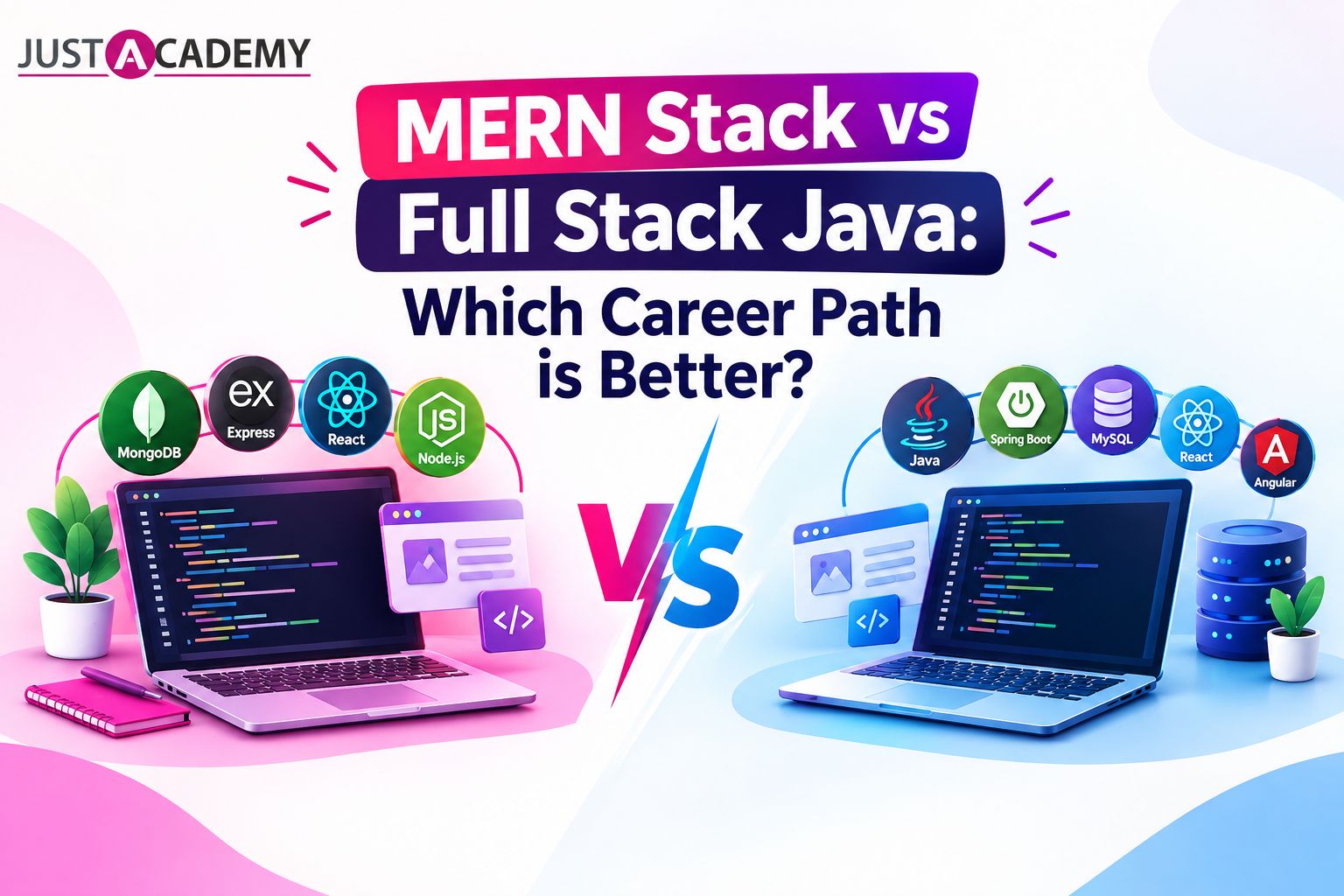
A practical comparison for Pune based learners choosing between MERN and Java full stack development, covering salary, learning curve, job roles, and long term career growth.